Agile Product Hub

Agile
ProductManager
ProductOwner
ScrumMaster
AgileHowToSeries
ProductStrategy
DigitalProduct
ProductLeadership
Pro Tips
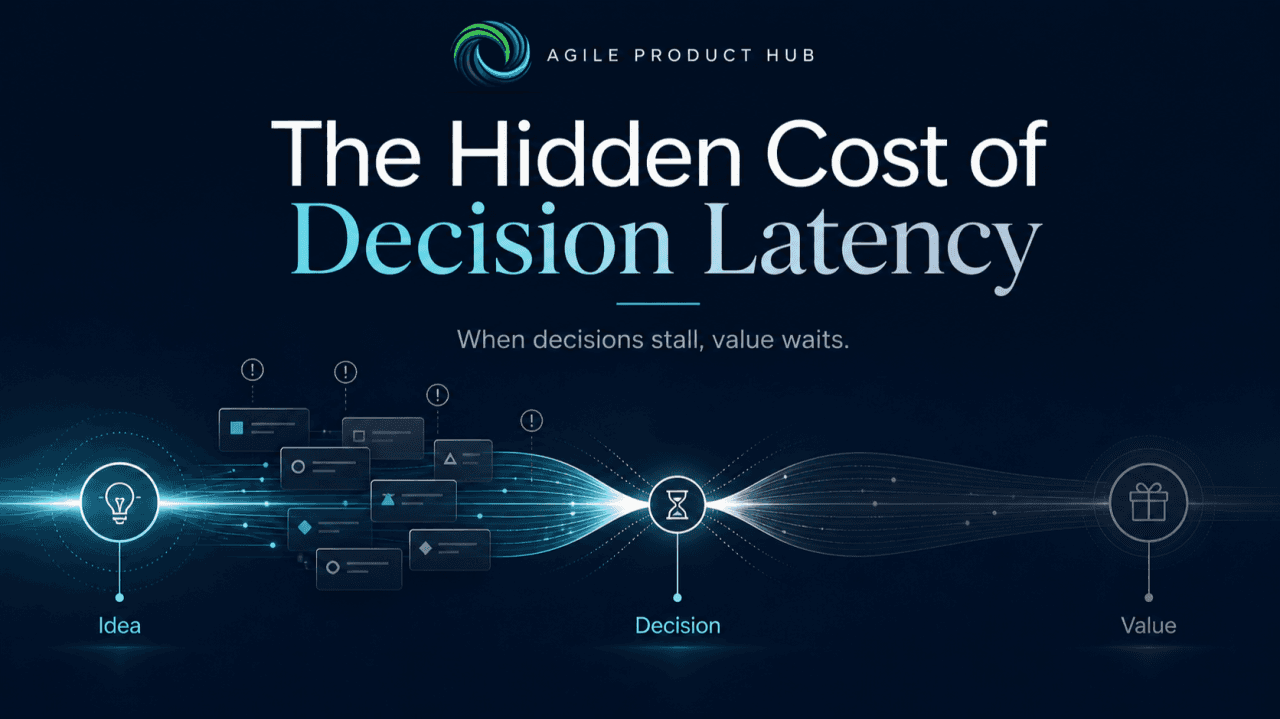
The Hidden Cost of Decision Latency
Most organisations can see when delivery is late.
They can see missed milestones, delayed releases, slipping roadmaps, rising defects, or teams carrying too much work in progress.
What they often struggle to see is the delay that happens before the delay.
The decision that waited for the right forum.
The trade-off nobody felt authorised to make.
The dependency that sat unresolved for three weeks.
The priority question that moved between leaders, product, engineering, design, and business without ever landing anywhere clearly.
This is decision latency.
It is the hidden delay between a decision needing to be made and that decision being made with enough clarity, confidence, and ownership for work to move forward. And in many organisations, decision latency quietly blocks more value than the delivery process itself.
The delay before the delay
When teams talk about delivery blockers, they often describe visible symptoms.
“We are waiting for sign-off.”
“We need clarity from leadership.”
“The dependency is with another team.”
“We need product to confirm the priority.”
“Engineering needs to assess feasibility.”
“The business needs to agree the trade-off.”
Each statement sounds reasonable on its own. Complex work does require collaboration. Product decisions do need context. Engineering decisions do need technical judgement. Business decisions do need commercial awareness.
The problem begins when the organisation cannot tell the difference between a necessary decision and a stuck one.
A necessary decision creates clarity.
A stuck decision creates drag.
Decision latency rarely appears as one dramatic failure. It shows up as small waiting points that accumulate across the system. A day here. A week there. A delayed refinement conversation. A postponed scope decision. An unresolved risk. A late design concern. A repeated escalation.
By the time delivery looks slow, the real delay may have started much earlier.
Slow decisions are not always cautious decisions
Many organisations describe slow decision-making as caution.
They say they are managing risk, protecting quality, aligning stakeholders, or ensuring the right voices are heard.
I agree, sometimes that is true, but often, slow decisions are not a sign of careful thinking. They are a sign that the system does not know where decision ownership really sits.
This is where the cost begins.
When decision ownership is unclear, teams wait.
When boundaries are vague, teams escalate.
When risk is not shared, people seek cover.
When leaders override decisions inconsistently, teams stop trusting their own authority.
When governance asks for certainty before learning has happened, teams delay the very experiments that would create confidence.
The organisation may believe it is being responsible... In reality, it may be teaching people that deciding is dangerous.
The cost is not just time
The obvious cost of decision latency is delay, but the deeper cost is more damaging.
Decision latency increases rework because teams move forward on assumptions while waiting for clarity. It increases cognitive load because people carry unresolved questions in the background while trying to make progress. It weakens ownership because teams learn that decisions are made elsewhere. It reduces trust because stakeholders see movement without confidence. It damages flow because work pauses, restarts, changes direction, then pauses again.
Over time, the organisation starts to compensate.
More meetings are added.
More stakeholders are included.
More status updates are requested.
More governance checkpoints appear.
More alignment forums are created.
Each addition is meant to reduce uncertainty, yet the system becomes heavier. The organisation becomes better at discussing decisions than making them.
That is the real hidden cost.
Not only does value arrive later, the system becomes slower at learning.
When alignment is mistaken for agreement
One of the reasons decision latency persists is that many organisations confuse alignment with agreement.
Agreement is a moment.
Alignment is a working condition.
A team can agree on the roadmap and still be misaligned when the first meaningful trade-off appears. Product may see a value risk. Engineering may see a feasibility risk. Design may see a usability risk. Business may see a viability risk.
No one is wrong. They are simply seeing different truths.
This is one of the core ideas behind Product Agile Harmony. Product, engineering, design, and business each bring a necessary perspective. The challenge is not to remove the tension between them. The challenge is to make that tension visible early enough for better decisions to emerge.
Decision latency grows when these perspectives meet too late.
If feasibility is explored after commitment, decisions slow.
If usability is tested after build, decisions slow.
If viability is considered after the team has shaped the solution, decisions slow.
If product intent is unclear, every downstream decision becomes harder than it needs to be.
Harmony is not created by forcing everyone to agree. It is created by helping people interpret the work through a shared understanding of intent, constraints, and trade-offs.
Escalation is a signal, not always a solution
Escalation is not inherently bad.
Some decisions genuinely need to move upwards or across the organisation. Strategic choices, investment trade-offs, regulatory risks, and cross-product impacts often sit beyond a single team’s authority.
The problem is compensatory escalation.
This happens when teams escalate because the system has made local decision-making unsafe or unclear.
They do not escalate because they lack capability.
They escalate because they have learned that making the decision alone carries too much risk.
This is why frequent escalation should be treated as a system signal.
What risk is the team trying to manage?
Which decision boundary is unclear?
What happened last time a similar decision was made?
Is escalation adding value, or simply providing cover?
Is the organisation using senior attention as a substitute for clear ownership?
When escalation becomes the default route to progress, autonomy becomes performative. Teams may be told they are empowered, but the system teaches them to wait.
Decision speed is a consequence, not the goal
It is tempting to respond to decision latency by asking people to make faster decisions.
That sounds sensible, but it misses the point.
Fast decisions made without shared context create rework.
Fast decisions made without ownership create blame.
Fast decisions made without learning create false confidence.
The aim is not simply to decide faster. The aim is to create the conditions where good decisions can happen closer to the work.
That requires three things.
First, clear intent. Teams need to understand the outcome, the constraint, and the trade-off that matters most.
Second, clear boundaries. People need to know which decisions they own, which decisions require consultation, and which decisions genuinely need escalation.
Third, shared risk. If teams carry the downside of decisions but do not share in the authority or support around them, hesitation is rational.
When those conditions exist, decisions move faster without being forced.
Where decision latency hides
Decision latency often hides in places that look normal.
It hides in refinement sessions where questions are raised but not resolved.
It hides in steering groups where decisions are discussed but deferred.
It hides in roadmaps that list commitments without making trade-offs explicit.
It hides in dependency boards that visualise blockers without changing ownership.
It hides in product backlogs where everything is prioritised but nothing is truly chosen.
It hides in leadership conversations where autonomy is encouraged but approval is still expected.
It hides in organisations that say “teams are empowered” while still requiring key decisions to travel upwards for reassurance.
These patterns are easy to miss because each one can be justified. The problem is not any single meeting, process, or governance step. The problem is the cumulative drag they create.
Reducing decision latency
Reducing decision latency does not mean removing all governance or pushing every decision down to teams.
It means designing decision-making deliberately.
Start by noticing where decisions repeatedly stall. Do not begin with a new framework. Begin with the pattern.
Where does work wait?
Where do teams seek permission for decisions they should be able to make?
Where do leaders get pulled into detail too often?
Where are trade-offs reopened after they were supposedly agreed?
Where does governance add clarity, and where does it add delay?
Then make the decision boundaries explicit.
For each meaningful type of decision, ask:
Who owns this decision?
Who needs to be consulted?
What constraints must guide the decision?
What level of risk is acceptable?
When should it be escalated?
What happens if the decision turns out to be wrong?
That last question matters. Decision confidence grows when people know they will be supported through learning, not punished for every imperfect outcome.
The leadership role
Leaders play a critical role in reducing decision latency.
Not by making every decision themselves, but by shaping the environment where decisions can happen well.
They provide intent.
They protect boundaries.
They avoid overriding local decisions unless there is a genuine reason.
They make trade-offs explicit.
They respond consistently when outcomes are uncertain.
They treat escalation as information, not reassurance.
This is where The Harmony Operating Model, THOM becomes useful as an operating lens. It asks leaders and teams to look beyond formal process and examine what the system is really reinforcing. If the system rewards escalation, people will escalate. If the system punishes uncertainty, people will hide risk. If the system values certainty over learning, decisions will slow at exactly the moment learning is needed most.
Decision latency is rarely a personal failing. It is usually a rational response to the signals the organisation sends.
The real question
When value delivery slows, the instinct is often to look at the team.
Are they working efficiently?
Are they estimating properly?
Are they focused enough?
Are they following the process?
Those questions may have a place, but they are not enough.
A better question is:
How easy does our system make it for the right people to make the right decisions at the right time?
Because if decisions are slow, unclear, repeatedly escalated, or constantly revisited, value will slow too.
Not because teams lack effort, not because people do not care, but because the system is asking value to move through uncertainty without giving people the clarity, trust, and authority to act.
Decision latency is not just a delay in choosing.
It is a delay in learning.
A delay in ownership.
A delay in value.
And once you start seeing it, you begin to notice how much of delivery performance is shaped long before delivery starts.
This is one of the tensions explored in Product Agile Harmony and developed further through The Harmony Operating Model, THOM. Because if organisations want faster flow, stronger ownership, and more consistent value delivery, they do not just need better delivery rhythms.
They need better decision conditions.
#AgileHowToSeries #ProductManagement #Agile #ProductOwnership #DigitalProduct #Leadership #AgileProductHub