Agile Product Hub
ProductManager
ProductOwner
ScrumMaster
AgileHowToSeries
ProductStrategy
DigitalProduct
AgileDelivery
Agile
Scrum
ProductLeadership
Why Product and Engineering Must Work Hand in Hand
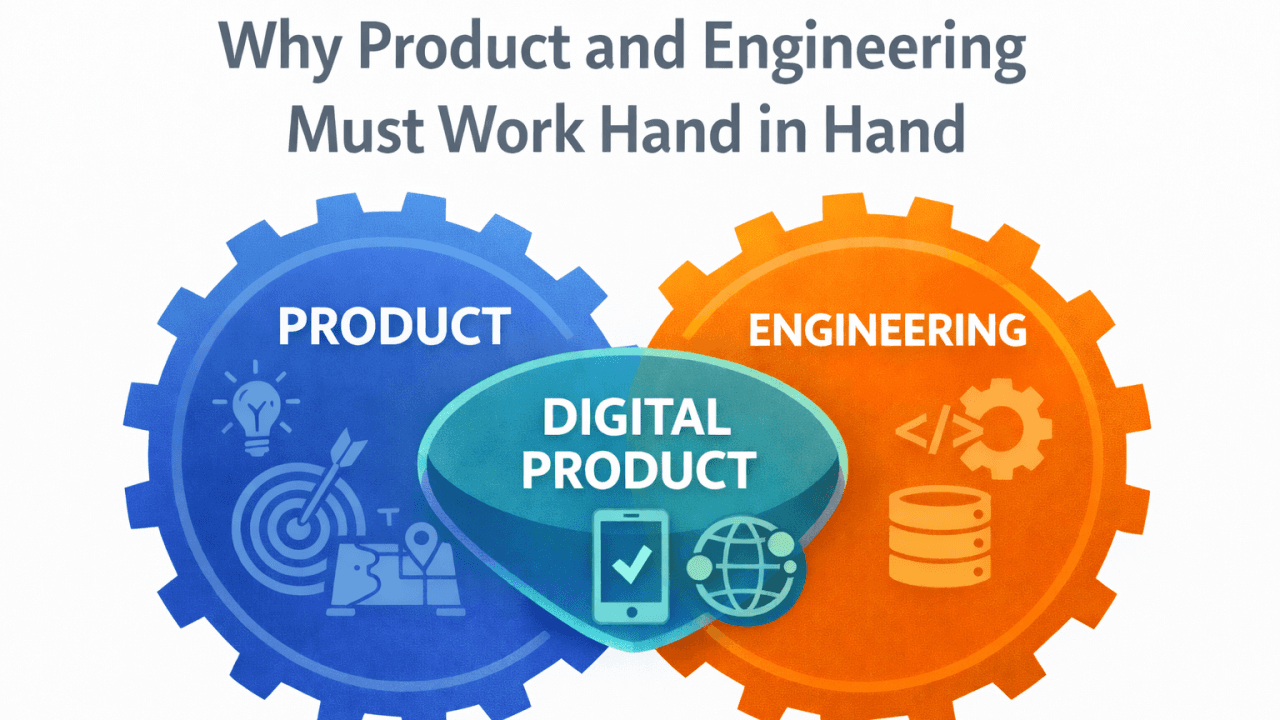
In many organisations, Product and Engineering are still treated as separate worlds.
Product owns direction. Engineering owns delivery. Product talks about value, outcomes, and customer needs. Engineering talks about architecture, feasibility, quality, and sustainability. On paper, that separation can look neat. It gives each function a clear space and a clear identity.
But digital products do not succeed that way.
The most effective digital organisations understand something important. Product and Engineering are not parallel functions that occasionally meet. They are a joint force. When they work well together, products move forward with clarity, pace, and purpose. When they drift apart, the organisation starts to feel the cost, often before it realises what is happening.
This is one of the most important shifts modern organisations still need to make.
Product is not there to define everything and hand work over. Engineering is not there to receive instructions and turn them into code. Strong digital products emerge when both disciplines shape the work together, from intent through to delivery and learning. That is when the product becomes more than a roadmap item and the engineering effort becomes more than a service.
That is when progress starts to mean something.
The old split still shapes too much of digital work
Many organisations have modernised their language without truly modernising how they work.
They talk about products rather than projects. They rename roles. They adopt agile practices within engineering, with some spillover into other areas. They introduce ceremonies, planning cadences, and backlogs. Yet underneath all of that, the operating assumption remains the same. Product decides. Engineering delivers.
It is a familiar split, and in some organisations it is so normal that few people even question it. But it creates hidden problems.
Product can become detached from the technical reality of what it is asking teams to do. Engineering can become detached from the customer and business context that gives the work its meaning. Delivery continues, but the connection between intent and execution becomes weaker.
The product may still move forward. Features may still ship. Roadmaps may still be updated. But something important changes when Product and Engineering stop shaping decisions together.
Product becomes theory. Engineering becomes a service. Delivery loses meaning.
That may sound harsh, but many teams know exactly what it feels like.
What Product brings
Product brings purpose. It helps the organisation understand what problem is worth solving, for whom, and why it matters. It connects work to customer needs, business goals, and the outcomes that the organisation hopes to create. It helps teams make choices rather than simply gather requests.
That role matters more than ever, especially in an age where AI is reshaping expectations, accelerating delivery, and forcing organisations to think more clearly about what real value looks like.
In modern digital work, organisations do not just need someone to manage a backlog or the roadmap. They need people who can interpret strategy, make trade-offs, and translate ambiguity into direction. As I wrote in Agile How To: Succeed as a Product Owner, the role acts as “the bridge between strategy and execution”.
But Product cannot do this well in isolation.
A product direction that ignores technical reality is not strategic. It is speculative. A roadmap that assumes Engineering can absorb everything is not ambitious. It is careless. Whether the Product Owner and Product Manager responsibilities are held by one person or split across two roles, they need to operate with near-total alignment. They do not need to be the same person, but they do need to think in the same direction and speak with a shared voice.
Product needs Engineering at the table early, not simply at the point of estimation or delivery.
What Engineering brings
Engineering brings feasibility, sustainability, and truth.
It helps the organisation understand what is technically possible, what is risky, what is fragile, and what is worth investing in now rather than later. It shapes architecture, quality, resilience, and the long-term health of the product. It does not just answer the question, “Can we build this?” It also helps answer the more important question, “What happens if we do?”
That is why engineering leadership is no longer just about technical execution or on-time delivery. As I explore in How to Lead in Agile as an Engineering Leader / Manager (coming soon), “The role of an engineering leader in Agile is no longer just about overseeing technical execution or ensuring on-time delivery. It is about enabling high-performing teams, fostering innovation, and aligning engineering excellence with business outcomes."
This is where many organisations still fall short.
They involve Engineering too late. Technical concerns are treated as constraints to manage rather than strategic inputs to consider. Architecture becomes a downstream conversation. Technical debt becomes something to squeeze in around feature delivery. Engineers are expected to react to direction rather than help shape it.
This may create the appearance of speed for a while. But it comes at a cost.
Engineering knows when the product direction is drifting away from delivery reality.
In How To Thrive as a Development Team Member in Scrum and Kanban, I wrote that “the business and product visions ensure that your work serves a purpose beyond just delivering features, it drives impact.” Developers often feel the cost of poor product decisions early, whether that shows up as unclear intent, rising rework, unstable priorities, or unhealthy trade-offs. They are not just implementers. They are part of the learning system.
Why digital products need both disciplines working together
Digital product development is not a relay race where one function passes work to another. While many physical product environments can tolerate more sequential handovers, digital work cannot. Digital product development is a learning system.
That learning happens when customer insight, product thinking, technical feasibility, and delivery experience inform one another continuously. Product needs Engineering to expose options, risks, and trade-offs. Engineering needs Product to provide clarity on purpose, value, and direction. Both need to stay close enough to the problem that they can adapt intelligently as they learn.
This is where a lot of organisations struggle.
They want Product and Engineering to collaborate, but they still structure the work in ways that keep them apart. Product meetings happen without Engineering. Technical decisions happen without Product context. Priorities get reset in one part of the system without understanding what that does elsewhere.
A lot of this is reinforced by the finance model. Products are often asked to own outcomes, yet the people, platforms, licences, and enabling capabilities they depend on are often funded through separate departmental budgets with different goals. When finance is fragmented in this way, collaboration becomes harder because accountability sits with the product while control is spread across the organisation.
Then the symptoms start to appear.
Priorities feel unstable. Delivery feels slower than it should. Decisions bounce around. Teams ask for more clarity. Stakeholders ask for more certainty. More meetings get added. More alignment work appears. The system becomes heavier, but not healthier.
This is not usually because people are failing. It is because the relationship between Product and Engineering has weakened.
Strong digital organisations work differently. Product shapes intent. Engineering shapes feasibility. Together, they shape outcomes. That is the real partnership.
This is not just about roles
It would be easy to treat this as a role discussion. Product Manager versus Product Owner. Head of Product versus Engineering Manager. Who owns what. Who decides what. Who attends which meeting.
Those questions matter, but they are not the main point.
The deeper issue is organisational.
As I explore in Product Agile Harmony (coming soon), “The system was the problem.” The relationship between Product and Engineering is shaped by the wider system around them. Governance, funding, portfolio structures, reporting lines, incentives, planning rhythms, and leadership behaviours all influence whether these disciplines can work well together.
If the organisation rewards local optimisation, delayed decisions, or output over outcome, then even capable people will struggle to create genuine partnership.
This is one of the core tensions in modern organisations. Roles mature, but the surrounding system often does not. That is when friction appears. A more mature Product function in a poorly aligned system will still feel constrained. A stronger Engineering capability inside old delivery assumptions will still feel like a service provider.
The answer is not more role clarity alone. It is better system design.
That is why Product and Engineering should be seen as a joint force, not two separate functions connected by handovers. Their relationship is not a delivery detail. It is one of the central conditions that shapes whether a digital organisation can actually learn, adapt, and create value.
A better way to think about it
Perhaps the simplest shift is this.
Stop thinking of Product Management as the owner of direction and Product Ownership and Engineering as the owner of delivery. That split is often reinforced in Scrum-shaped organisations, where Agile is reduced to an engineering implementation and the Product Owner is treated as a mechanism for pulling ownership back from product management.
In strong digital organisations, Product Management, Product Ownership, and Engineering work as one connected system, shaping direction, feasibility, and delivery together.
Start thinking of Product and Engineering as shared stewards of progress.
Product keeps the work anchored in value, user need, and strategic intent. Engineering keeps the work grounded in technical reality, sustainability, and delivery integrity. Neither can succeed fully without the other.
The best organisations recognise this early. They do not wait for tension to build. They create the conditions where Product and Engineering can think together, challenge together, and learn together.
That does not remove disagreement. It makes disagreement useful.
And that is often where stronger products begin.
If Product and Engineering are not shaping outcomes together, delivery may still move, but meaning starts to fade.
If this theme resonates, I explored it in more depth in last week’s Deep Dive podcast: Leading Product in Modern Digital Engineering. Available on your favourite podcast platform.
#AgileHowToSeries