Agile Product Hub
ProductManager
ProductStrategy
DigitalProduct
ProductLeadership
Pro Tips
Why Product Strategy and Delivery Drift Apart
#AgileHowToSeries
Strategy is one of the most discussed topics in product and digital organisations. Leadership teams spend time defining it, debating it, and presenting it. Strategy decks are created. Roadmaps are aligned. Objectives are announced.
Yet many teams experience a familiar tension a few months later.
The strategy looks clear in presentations, but the day-to-day work inside the backlog feels disconnected from it. Teams are busy. Features are being built. Roadmaps are progressing. Delivery metrics show movement.
But leaders begin asking a quiet question. "Why does what we are building feel different from the strategy we agreed?"
This disconnect rarely comes from poor intent. It usually emerges from something far more subtle. Strategy and delivery operate at very different levels of abstraction, and the bridge between them is often weaker than organisations realise.
When that bridge is weak, strategy slowly drifts away from delivery decisions.
Strategy lives at altitude
Strategy is designed to operate at a higher level of thinking.
Strategy defines direction, positioning, and opportunity.
A strategy might describe ambitions such as:
Expanding into a new market segment
Improving customer onboarding
Increasing retention or engagement
Differentiating through a specific capability"
These statements describe intent and direction. They explain what the organisation is trying to achieve and why it matters.
Delivery teams, however, operate at ground level. Their work consists of tasks, backlog items, and technical changes.
A typical delivery backlog contains items such as:
Implement new registration fields
Update user authentication flow
Improve dashboard layout
Create API integration
Both levels are valid. Strategy needs to remain directional and flexible, while delivery requires clarity and specificity.
The problem appears when there is no structured translation between the two.
Without that translation layer, teams move from strategic ambition straight into tactical work. The original intent becomes diluted as it passes through multiple layers of interpretation. Over time, strategy becomes something teams once discussed rather than something that actively guides their decisions.
How drift begins
Strategy rarely travels directly from leadership to a development team.
Instead, it moves through several organisational layers.
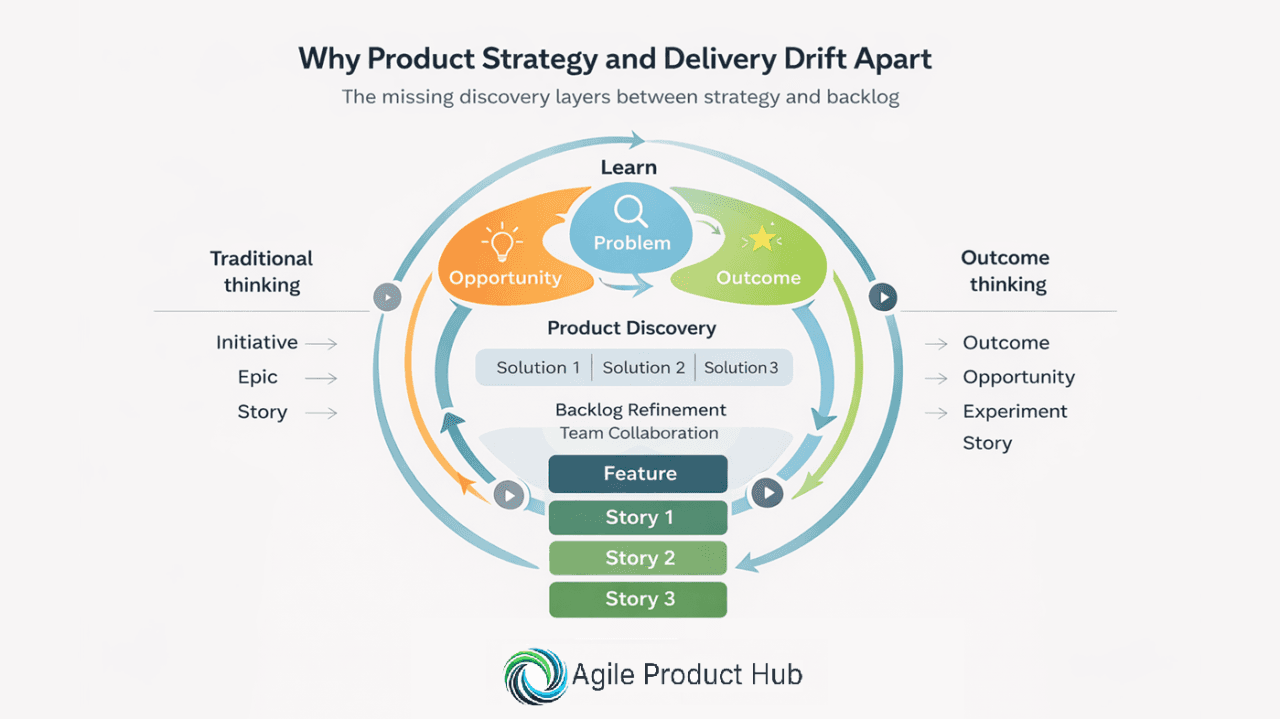
A typical path might look something like this: Leadership intent - Portfolio planning - Product roadmaps - Initiatives or epics - Backlog items
Each layer introduces interpretation.
The portfolio layer decides which areas deserve investment.
Product leaders convert strategic themes into initiatives.
Product teams translate initiatives into features.
Delivery teams break features into backlog items.
None of these steps are wrong. They are necessary.
However, each step subtly reframes the original intent. Small changes accumulate as the strategy travels downward through the organisation.
By the time it reaches the backlog, the connection to the original strategic goal may be far weaker than expected.
Consider a simple example: A strategy might aim to improve customer onboarding.
At the initiative level this becomes a programme focused on onboarding improvements.
At the product level it becomes features such as onboarding dashboards or guidance flows.
At the backlog level it becomes tasks like updating registration forms or adding progress indicators.
Each change may be logical. Yet the original strategic question, what actually improves onboarding success, may never be revisited.
This is how drift occurs. Not through bad decisions, but through gradual reinterpretation. When you move from organisational strategy to product strategy, we expect interpretation, a single product will most likely not deliver the entire organisational strategy.
Delivery systems reward activity
Another factor contributing to strategy drift is how delivery systems measure success.
Most organisations track delivery progress through operational metrics such as:
Velocity
Number of stories completed
Features delivered
Roadmap milestones achieved
These signals are useful for understanding team capability, team capacity and operational flow. However, they measure activity rather than impact.
If success is defined by completing backlog items, teams will optimise for completing backlog items.
The strategy might say: Increase customer activation by 30 percent.
The delivery system might reward: Complete these twenty planned features.
Once these two signals diverge, the system begins reinforcing the wrong behaviour.
Teams continue delivering work efficiently, but the connection between that work and the intended outcome becomes weaker.
Over time this creates a paradox.
Teams feel productive because they are delivering consistently whilst leadership feels uneasy because the outcomes they expected are not materialising.
The missing conversations
Another reason strategy and delivery drift apart is that the conversations needed to connect them often do not happen.
Product work is rarely the result of a single decision. It is the outcome of several perspectives coming together.
For strategy to influence delivery decisions, teams must regularly explore four important questions.
The value conversation asks what problem we are trying to solve and why it matters for the customer or the organisation.
The feasibility conversation explores what is technically possible and what constraints shape our choices.
The usability conversation focuses on whether customers will actually understand or benefit from the solution.
The viability conversation ensures the work aligns with commercial priorities and organisational direction.
When these conversations happen regularly, teams remain connected to the strategic intent behind the work.
When they do not, teams default to executing what has already been written down.
Backlogs become task lists rather than decision frameworks.
The backlog is not strategy
Backlogs are powerful tools for organising work, but they were never designed to express strategy.
A backlog contains fragments of intent. It lists tasks and features that need to be built.
What it rarely contains is the full context behind those tasks.
A backlog item might describe the functionality required, but it usually does not explain:
The strategic reason the work matters
The outcome it should influence
The trade-offs that led to the decision
Without this context, backlog decisions become local optimisations.
Teams make reasonable choices within the scope of the item in front of them. However, they may not understand the broader problem the organisation is trying to solve.
The result is delivery efficiency without strategic clarity.
Organisations that maintain alignment
Some organisations manage to keep strategy and delivery tightly connected.
They do not do this by writing better strategy documents. They do it by shaping how strategy flows through the system.
Several patterns tend to appear in these environments.
First, they define clear product outcomes rather than focusing solely on features. Teams understand what success looks like in terms of behaviour change, customer impact, or business results.
Second, they create durable product ownership. Teams remain responsible for a product area long enough to connect their work with measurable outcomes.
Third, they revisit strategy frequently. Strategy is not a once-a-year announcement. It becomes a recurring conversation that evolves as teams learn.
Fourth, they integrate discovery with delivery. Teams explore problems, test assumptions, and validate ideas before committing to large feature investments.
Finally, they maintain transparency around decisions and trade-offs. Teams understand not just what they are building, but why certain priorities were chosen over others.
These practices create a living connection between strategy and everyday work.
When teams understand the intent behind their work, they are better equipped to make good decisions as conditions change.
Turning strategy into everyday decisions
Strategy only becomes meaningful when it shapes the small decisions teams make every day.
Which problem should we prioritise next?
Which idea deserves an experiment before we commit to building it?
Which trade-off will create the most long-term value?
What should we decide not to build?
When teams have clarity about strategic intent, they do not simply execute tasks. They interpret, adapt, and learn.
They become active participants in strategy execution rather than passive recipients of instructions.
This shift changes the role of delivery teams entirely.
Instead of focusing purely on completing work, teams focus on improving outcomes.
Strategy stops being something that lives in slide decks and becomes something that lives inside daily decisions.
A final reflection
Strong strategies are not rare. Many organisations invest heavily in defining their ambitions and priorities.
What is far rarer is the ability to carry those ambitions through to the daily work of product teams.
The gap between strategy and delivery is not caused by lack of effort. It is caused by how work flows through the system.
When strategy, product thinking, and delivery practices are connected, that gap becomes much smaller.
Teams remain grounded in the problems they are trying to solve, even as they move through the practical realities of building software and services.
That is when strategy stops drifting.
It starts guiding the work instead.
Strategy should not live only in presentations.
It should live in the decisions teams make every day.
#AgileHowToSeries #ProductStrategy #ProductManagement #AgileLeadership